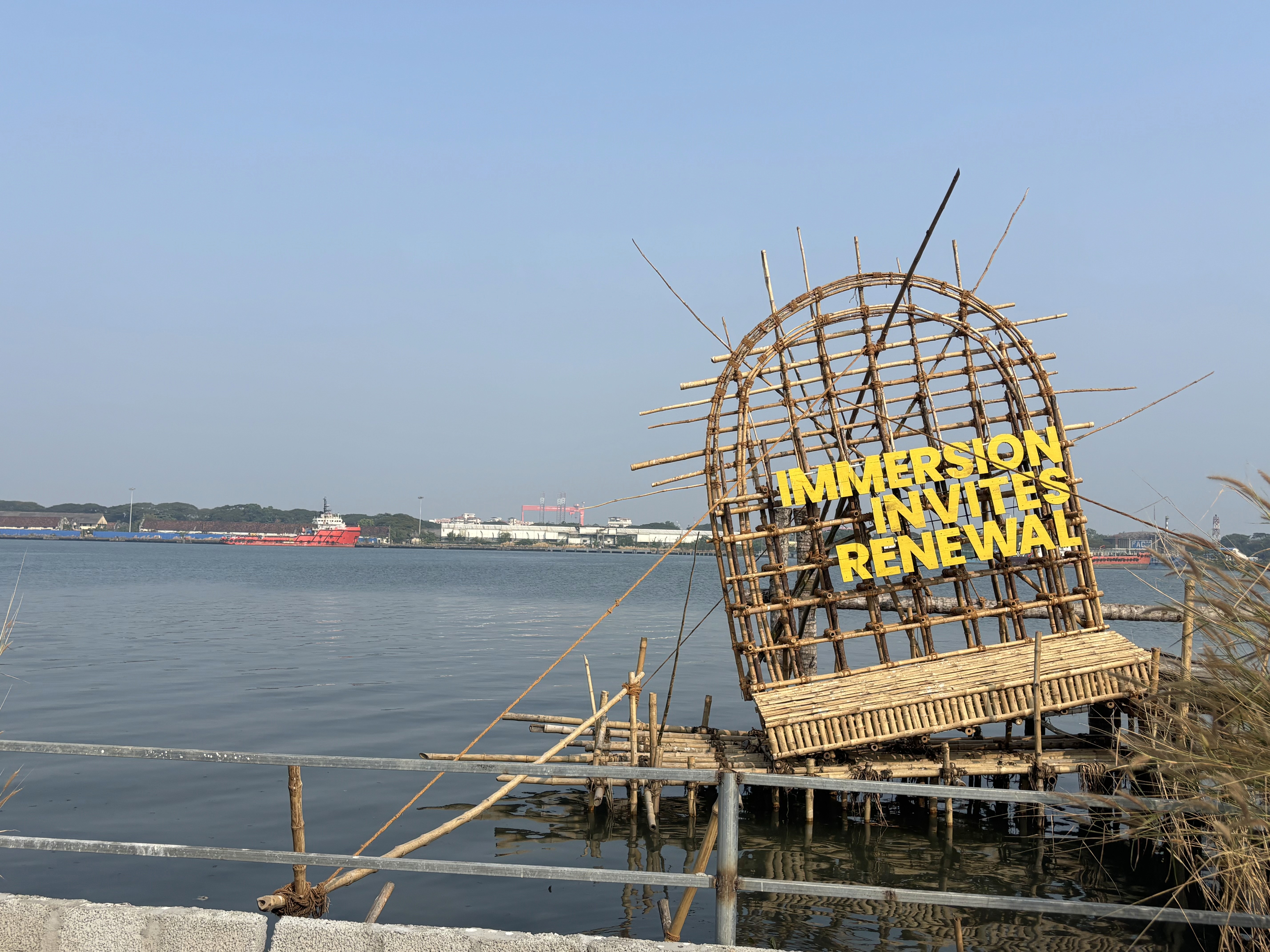
Immersion invites renewal
Renewal doesn’t have to begin with a grand resolution. Sometimes it starts with a pause: a moment to take a breath, look at what you’ve been doing, and consider what might no longer be serving you.
The same is true of sustainability communications. Reports, proposals, websites, presentations, and other documents can gradually accumulate layers of language, terminology, repetition, and complexity. Over time, even good content can become harder to navigate and less effective at communicating what matters.
Editing offers an opportunity to step back and reconsider.
It isn’t about changing everything. Often, it’s about letting go of what isn’t needed, bringing important information into clearer focus, and making room for the ideas that deserve attention. Small, thoughtful changes can make a substantial difference.
This idea of renewal, of letting go of the old and making space for something new, feels especially poignant to me. While in Kochi, India, during the Muziris Biennale, I came across an exhibit celebrating the vibrant Durga Puja festival held each year in Kolkata. Standing by the Arabian Sea, I was struck by a sign that echoed the spirit of Visarjan, the ritual immersion of clay idols into the water.
It is a farewell, but also a promise. A symbolic act of letting go that makes room for regeneration and new beginnings.
Renewal through words
That idea has stayed with me.
In sustainability communications, we can sometimes become so focused on adding more that we overlook the value of taking something away. More detail. More qualifications. More terminology. More explanation.
But more isn’t necessarily clearer.
Good editing can help us identify what is essential and what is getting in the way. It can remove unnecessary jargon and repetition, bring important information to the foreground, make complex ideas easier to follow, and create consistency in terminology, tone, and structure.
It can also reveal something less obvious: gaps, ambiguities, and contradictions that might otherwise remain hidden beneath layers of text.
For sustainability professionals, this matters. The subject matter is often inherently complex, involving technical concepts, regulatory requirements, reporting frameworks, environmental and social impacts, and multiple stakeholder perspectives. The answer isn’t to simplify the substance to the point where it loses its meaning. It’s to make that substance easier for people to understand.
Sometimes that means editing what already exists. Sometimes it means starting again and finding a clearer way to tell the story.
Making space for what matters
Renewal doesn’t require perfection. It can simply mean making something a little clearer, more focused, and more useful than it was before.
Perhaps there’s a report sitting on your desk that could benefit from another pair of eyes. Perhaps your sustainability messaging has become cluttered over time. Perhaps you’ve been trying to explain something complex and know that there must be a more straightforward way to say it.
Start there.
Read it again. Ask what needs to stay, what could go, and what deserves greater emphasis. Consider whether your reader will understand what you’re trying to say – and whether they’ll still be paying attention by the time they reach the end.
Good writing isn’t necessarily about saying more. Often, it’s about saying what matters, clearly and deliberately.
Like Visarjan, the act of immersion reminds us that letting go can itself be a form of renewal. Sometimes, making space is the first step towards creating something better.
—
Sometimes better communication starts with letting something go. Let’s look at what your content could lose, refine or rethink – and what might emerge as a result.